
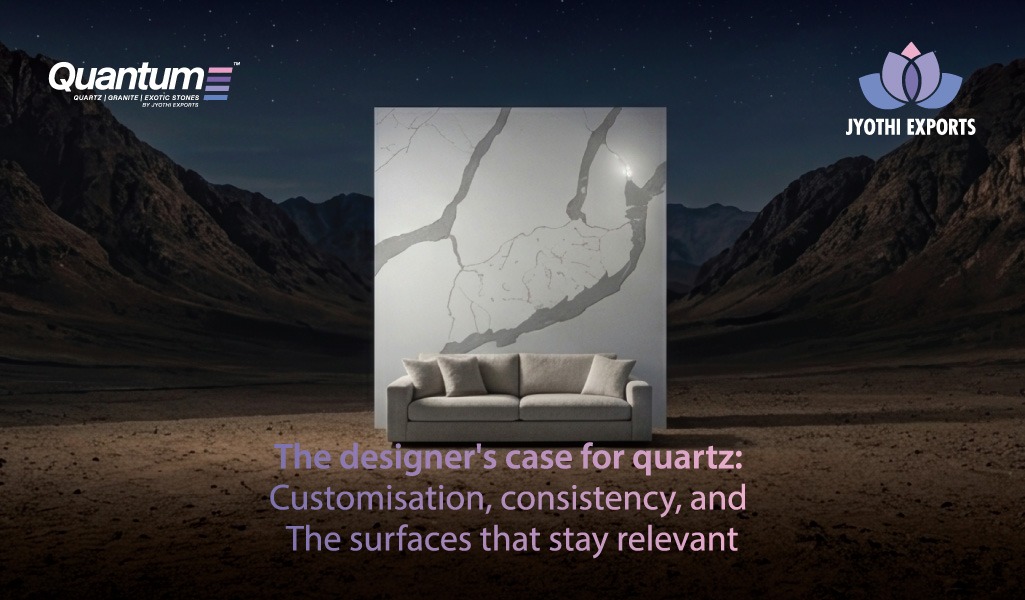
Ask a designer what they want from a surface and the answer rarely starts with material. It starts with intent. They describe the feeling they want the space to carry; the quality of light in the room, the mood it should set for the person walking into it, the relationship between the surface and everything else that’s been specified around it.
Then they choose the material capable of bringing that vision to life. And increasingly, that material is Quartz.
Not because quartz is new, or fashionable, or because it’s appeared on every design platform for the past three years. But because when you understand what it actually offers – as a design tool, not just as a surface; it solves problems that other materials leave open.
Customisation That Begins With Design Intent
The most valuable characteristic of engineered quartz isn’t what it looks like. It’s the ability to decide exactly what it should look like.
Natural stone offers beauty through uniqueness. Every slab is different, shaped by geological processes that span thousands of years. The designer’s role is to select from what nature provides. Engineered quartz changes that equation. The design vocabulary is set by the manufacturer. The designer selects from a range built to carry specific visual characters with precision.
This means the surface decision can be made in the context of the full design brief, not in spite of material limitations. If the brief calls for a marble-like surface that reads warm and editorial – Calacatta LUX or Carrara Gold. If it calls for something dark, precise, and dramatic – Black Sparkle. If it needs to be quiet, considered, and capable of sitting across large areas without demanding attention – Statuario Grey or Carrara Grey.
Each of these is a design decision, not a material compromise. That’s what customisation through engineering makes possible.
Consistency as a Design Principle
There’s a version of material selection that treats consistency as a technical requirement – something the project manager cares about, not the designer. This undersells what surface consistency actually delivers in a finished space.
When a material is consistent, when the colour and pattern hold across every slab in the installation – it allows the design to do what it was meant to do. The surface becomes a ground. The architecture, the furniture, the light; all of these read cleanly against a material that doesn’t compete for attention through variation it didn’t plan for.
This is where engineered quartz demonstrates its greatest advantage. Precision manufacturing ensures that what the designer specifies is what ultimately arrives on site.
At Jyothi Exports, that precision is achieved through a 145-metre integrated Pedrini processing line that calibrates and controls every stage of production. The result is a surface finish that is engineered rather than approximated, delivering the same visual quality from one slab to the next.
For designers who’ve worked with inconsistent materials – a batch of natural stone where the second delivery read differently from the first, a surface that looked right in the showroom and different in site conditions – this reliability is not a small thing. It is the difference between a design that holds and one that requires constant management.
The Ongole Manufacturing Story
When we talk about engineered quartz at Jyothi Exports, we’re talking about a facility built with one ambition: to produce the highest quality engineered quartz surface in India, at a scale that can meet international demand.
At Jyothi Exports, engineered quartz is produced at a dedicated facility in Ongole, Andhra Pradesh—a region already known internationally for its natural stone expertise. It is here that the company combines decades of stone-processing knowledge with advanced engineered surface technology.
The facility operates two fully automated casting lines and produces up to six lakh square metres of engineered quartz annually. At the heart of the operation is the Pedrini Avantgarde system—a first-of-its-kind installation in India—designed to handle calibration, polishing, and precision trimming within a fully integrated 145-metre production line.
For designers and specifiers, these details matter.
A surface is only as dependable as the process behind it. Understanding how a material is manufactured provides confidence in how it will perform—not just in a sample presentation, but across an entire project.
Where Quartz Delivers in Practice
The designer’s case for quartz is ultimately built on what it delivers in real spaces, under real conditions. The theory is only as good as the application.
Residential kitchens remain one of the clearest examples. Daily use places enormous demands on a surface, from food preparation and spills to heat exposure and constant cleaning. Quartz responds with a combination of scratch resistance, non-porosity, colour stability, and durability that makes it exceptionally suited to modern living.
Bathrooms and wellness environments present a different challenge. Constant exposure to moisture, personal care products, and cleaning agents can affect many surface materials over time. Quartz’s non-porous structure eliminates the need for sealing while helping maintain its appearance year after year.
Commercial environments demand even more.
Hotels require visual continuity across multiple rooms and locations. Healthcare spaces depend on hygienic, easy-to-maintain surfaces. Retail and office interiors need materials capable of handling heavy daily use without compromising appearance.
Engineered quartz delivers across all of these settings because it combines durability with predictable performance at scale.
Increasingly, architects are also specifying quartz for statement applications—feature walls, reception desks, large-format panels, and other architectural surfaces where visual impact must be matched by long-term reliability. In these environments, precision manufacturing becomes just as important as aesthetics.
The Material That Matches the Brief
Ultimately, a designer’s relationship with any material is built on trust.
Can it achieve the intended visual outcome? Will it look on site the way it looked in the sample? Will it continue to perform years after installation?
Engineered quartz answers those questions with confidence.
Its design range offers the flexibility to support a wide variety of creative briefs. Its manufacturing precision provides the predictability required for projects of every scale. And its performance characteristics allow those designs to maintain their quality without the ongoing maintenance associated with many natural materials.
That is the designer’s case for quartz.
Not because it replaces natural stone.
Not because it imitates something else.
But because it delivers exactly what modern design increasingly demands: creative freedom, manufacturing precision, dependable performance, and the confidence that design intent will survive the journey from concept to completion.
And in the end, when it’s made well, it makes the designer’s job easier, not harder.