
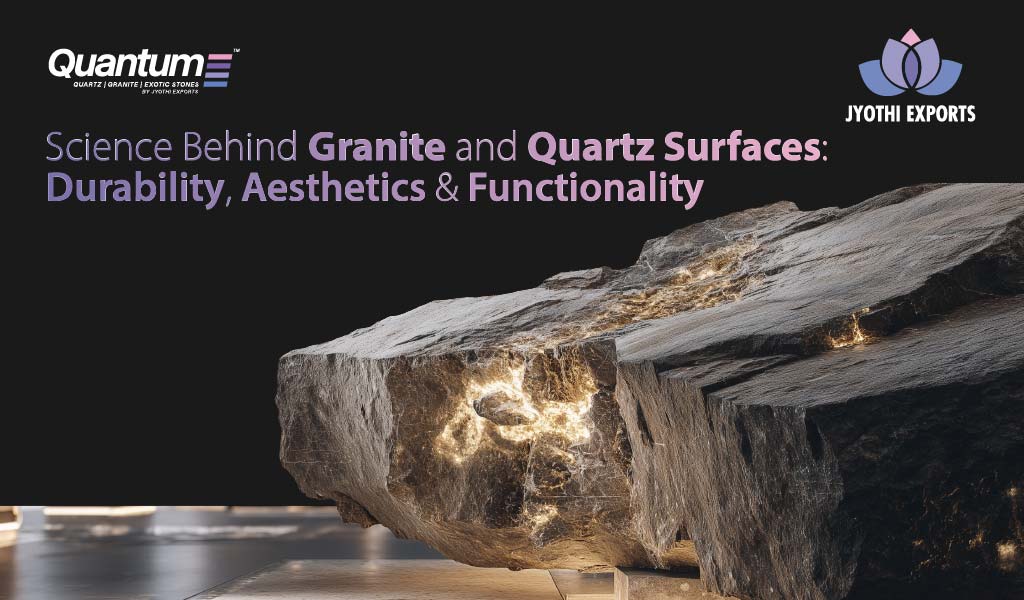
Granite and quartz have become the cornerstone of modern architecture and interior design. Beyond their visual appeal, the science behind these surfaces explains why they continue to dominate residential and commercial spaces. From geological formation to engineered precision, their durability, aesthetic depth, and functionality are rooted in material science.
The Science of Granite: Nature’s Strength
Granite is an igneous rock formed deep beneath the Earth’s surface. It is created when molten magma cools and crystallises over millions of years. This slow crystallisation process forms interlocking mineral grains, primarily quartz, feldspar, and mica.
The tightly bonded mineral structure is what gives granite its exceptional durability. Scientifically speaking, granite ranks high on the Mohs hardness scale, making it highly resistant to scratches and surface wear. Its crystalline structure also allows it to withstand high temperatures without damage, which is why it performs exceptionally well in kitchens and high-usage areas.
Granite’s durability is not just about hardness. Its density and compressive strength make it capable of bearing significant weight and stress without cracking. This makes it suitable for countertops, flooring, cladding, and large-scale architectural installations.
The Engineering of Quartz: Precision and Performance
Unlike granite, quartz surfaces are engineered stones. They are manufactured by combining natural quartz crystals with resins and pigments under intense pressure and vibration. The result is a non-porous, highly uniform surface with enhanced performance characteristics.
Natural quartz itself is one of the hardest minerals on Earth. When engineered into slabs, it becomes even more functional due to controlled composition and manufacturing precision.
The resin binders fill microscopic gaps, creating a surface that resists staining, bacterial growth, and moisture penetration. From a scientific perspective, quartz surfaces are designed for consistency. This eliminates natural fissures and weak points, making them ideal for applications requiring predictable performance.
Durability: The Core Advantage
The durability of granite and quartz is grounded in their mineral composition and structural integrity.
Granite offers:
- High resistance to heat and scratches
- Strong compressive strength
- Long lifespan with minimal structural degradation
Quartz provides:
- Non-porous surface resistant to stains
- Low maintenance with no sealing required
- Enhanced impact resistance due to engineered bonding
This scientific resilience translates into practical longevity. Whether in homes or commercial environments, both materials maintain structural and visual integrity over decades.
Aesthetic: Where Science Meets
Art The aesthetic appeal of granite is a result of natural mineral variations. Each slab carries unique patterns formed by geological processes over millions of years. Variations in feldspar and mica create colour shifts and movement, giving granite its organic beauty.
Quartz, on the other hand, achieves aesthetic precision through design engineering. Pigments and aggregates are added during production to create consistent colours, veining patterns, and contemporary finishes. This makes quartz ideal for projects that require uniformity across large spaces.
- Rich textures and depth
- Wide colour spectrum
- Polished, matte, or textured finishes
The science of light reflection also plays a role. Polished granite and quartz reflect light differently based on crystal size and surface finishing techniques, enhancing spatial perception in luxury interiors.
Functionality: Designed for Modern Living
Functionality goes beyond strength. It includes hygiene, maintenance, adaptability, and long-term performance.
Granite’s heat resistance makes it ideal for kitchen countertops and outdoor applications. When sealed properly, it resists moisture and staining. Its structural integrity supports heavy installations such as large islands and staircases.
Quartz excels in controlled environments where hygiene and low maintenance are critical. Because it is non-porous, it does not harbour bacteria or require periodic sealing. This makes it suitable for bathrooms, healthcare spaces, hospitality, and high-traffic commercial areas.
Applications Across Spaces
Granite and quartz are used in:
- Countertops and kitchen islands
- Flooring and wall cladding
- Staircases and feature walls
- Commercial reception desks and workspaces
Their adaptability stems from both natural geological properties and modern fabrication techniques.
The Future of Stone Surfaces
Advancements in cutting, polishing, and surface treatment technologies continue to enhance the performance of granite and quartz.
Precision CNC fabrication ensures accurate dimensions, while innovative finishes improve slip resistance and durability.
The science behind granite and quartz is a blend of natural formation and engineered advancement. Together, they represent materials that are not only aesthetically compelling but scientifically built for durability and functionality.
In a world that demands performance without compromising beauty, granite and quartz stand as a testament to how science and design can coexist seamlessly.