
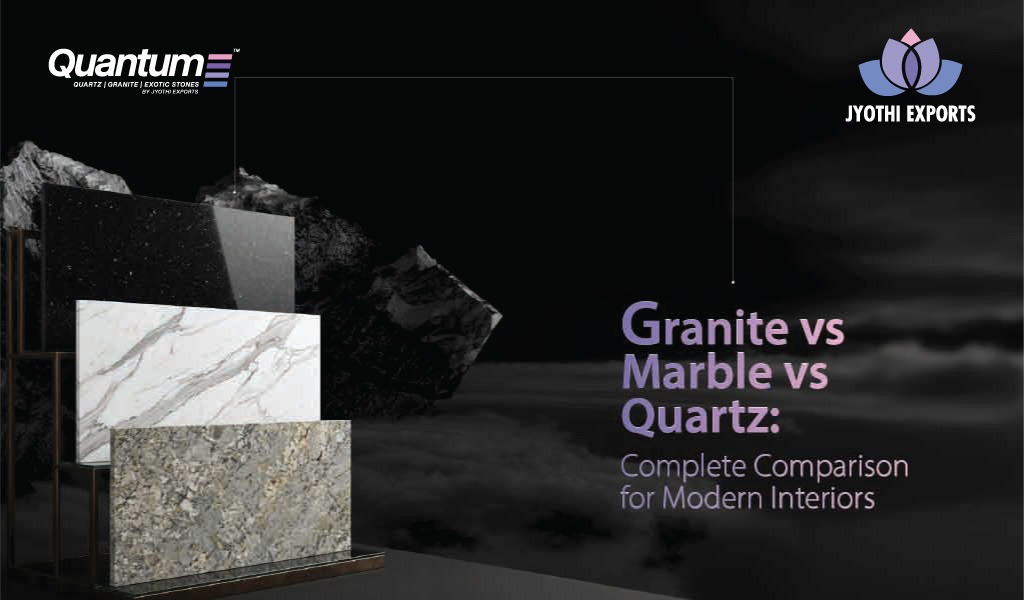
Three materials. Dozens of opinions. The honest answer is that granite, marble, and quartz each do specific things well, and choosing between them is mostly a matter of being clear about what the project actually needs.
Here’s how they compare across the factors that change the decision.
What Each Material Is
Granite is a natural igneous rock. It’s quarried in large blocks, cut into slabs, and finished to specification. No two slabs are identical.
Marble is a natural metamorphic rock formed when limestone recrystallises under heat and pressure. The veining comes from mineral impurities — iron, clay, trace elements — distributed through the stone during formation.
Engineered quartz is manufactured: roughly 90–93% natural quartz aggregate combined with resins and pigments under controlled conditions. It looks like natural stone but doesn’t behave like it.
Durability
When comparing marble vs granite durability, granite wins for most functional environments. It scores 6–7 on the Mohs hardness scale, handles heat without degrading, and resists chipping well in heavy-use applications. It’s the standard for exterior cladding and surfaces with direct thermal exposure.
Marble sits at 3–4 on the Mohs scale — softer, and susceptible to etching from acidic liquids like wine, lemon juice, or common kitchen cleaners. In high-traffic flooring, wear shows faster than it does with granite or quartz. Marble belongs in spaces where it won’t be tested daily.
Quartz scores around 7 on the Mohs scale. It’s scratch-resistant, non-porous, and the most durable countertop material for controlled indoor environments. One limit: the resin binder can discolour under sustained direct heat above roughly 150°C, so hot pots directly on quartz surfaces aren’t advisable.
Maintenance
Granite needs sealing — once a year is the standard for polished surfaces. Without it, the stone’s natural pores absorb oils and liquids over time. With basic upkeep, it lasts for decades without issue.
Marble also needs sealing, but sealing alone doesn’t prevent etching. Acidic substances will dull a polished marble surface regardless. Some designers treat that patina as part of the material’s character. In a kitchen or commercial setting, it’s a maintenance problem.
Quartz needs nothing. Soap and water. No sealing schedule, no mineral sensitivity. For commercial environments where cleaning is frequent and consistent, quartz is the operationally simple option.
Aesthetics
Marble is the hardest to replicate and the most visually complex of the three. The depth of its veining, the way it shifts under different light conditions — manufacturing gets close but hasn’t fully matched it. That’s why marble still gets specified for statement applications: hotel lobbies, premium bathrooms, reception counters where first impressions carry weight.
Granite reads more uniformly. The texture and mineral structure give it depth, particularly in polished form, but the overall character is quieter than marble. The black varieties — Black Pearl, Black Galaxy — work in premium contexts without marble’s maintenance obligations.
Quartz aesthetics have improved considerably. Surfaces replicating Calacatta and Carrara patterns are now convincing enough that most people can’t identify them without context. For large projects, quartz delivers exact consistency across a full batch — something natural stone can’t guarantee.
Which Is Best for Kitchens?
For quartz vs granite countertops in kitchens, both are practical. Marble is not, for most projects.
Granite handles heat from cookware and performs well with annual sealing. Quartz doesn’t stain, needs no sealing, and is non-porous — which matters in food preparation environments. Between the two, quartz is lower maintenance; granite has a slight edge in heat tolerance. Marble etches on contact with common kitchen acids and requires daily discipline that working kitchens rarely sustain.
For buyers who want the best countertop material that balances durability, hygiene, and ease of care, engineered quartz is the practical answer for kitchens. Granite is the better choice for outdoor kitchens or surfaces near open flame.
Pricing
Quartz is generally more expensive than standard granite varieties, though the gap narrows with premium granite like Black Galaxy or rare regional varieties. Marble covers the widest price range — common varieties are mid-market, while Calacatta and Statuario sit at the high end. For large-volume procurement, Indian granite offers the most consistent price-to-quality ratio across most application categories.
What Architects Actually Specify
For hospitality, retail, and public interiors, granite and quartz are the standard. They perform at scale and don’t require ongoing intervention.
In premium residential projects, engineered quartz has become the dominant kitchen and bathroom specification over the last several years. The maintenance argument is part of it. The Calacatta and Carrara quartz surfaces have also become credible enough that the design brief can be met without the upkeep of real marble.
Exterior work, landscape architecture, and structural surface applications still belong to granite. Neither marble nor quartz is a realistic alternative there.
Which is better — granite, marble, or quartz for kitchens?
Granite and quartz are both well-suited to kitchens. Quartz is non-porous, needs no sealing, and resists staining — making it the lower-maintenance option. Granite handles direct heat better and is the stronger choice near cooking surfaces or outdoor kitchens. Marble is not recommended for most kitchen applications because it etches from common kitchen acids like lemon juice, vinegar, and wine.
What is the difference between granite, marble, and quartz?
Granite is a natural igneous rock formed under intense heat and pressure — hard, heat-resistant, and unique in every slab. Marble is a natural metamorphic rock with characteristic veining, softer than granite and prone to etching. Engineered quartz is a manufactured surface made from roughly 90–93% natural quartz aggregate bound with resin — consistent, non-porous, and the lowest maintenance of the three.
Which material is most durable for countertops?
Engineered quartz is the most durable countertop material for indoor use — it scores around 7 on the Mohs hardness scale, is non-porous, scratch-resistant, and requires no sealing. Granite is equally hard and more heat-resistant, making it the better choice for outdoor surfaces or high-heat kitchen environments. Marble is the least durable of the three for countertop applications.
Is quartz more expensive than granite?
Generally, yes. Engineered quartz typically costs more per square metre than standard granite varieties. However, premium granite — Black Galaxy, rare regional colours — can match or exceed quartz pricing. The total cost difference also narrows when granite’s sealing and maintenance costs are factored in over time.
What do architects prefer for modern interiors?
It depends on the application. For hospitality, retail, and large commercial interiors, granite and quartz dominate — they perform reliably at scale. For premium residential kitchens and bathrooms, engineered quartz has become the most common specification because of its low maintenance and consistent aesthetics. Marble is reserved for feature applications where visual impact is the priority and a maintenance plan is in place. Granite remains the preferred material for exteriors and structural surface applications.